
One page PDF providing not one, not two, but TEN easy, FREE tips from the state of Colorado to help homeowners save money on their energy bills. While not all of the information applies in California, it is a good resource, and many of these programs are also available in California under the auspice of various non-profits. You can visit the PDF at it's original home at: http://smartenergyliving.org/Library/PDF/SELfallwinter08/SEL_Fall08_08.pdf or also off of our webpage in the resources section.
So, the best tips off of this particular page?
(Tip #7) Find an ECO Broker. These are real estate agents who have been certified in identifying and selling properties that are going to save you money. This is important because, it has been proven that energy savings appliances will save you a considerable amount of money in the long run. And if you are buying a home that already has energy savings measures in place - you reap the benefits of cost efficiency, without having to pay the higher costs of install. It's a win-win situation. You get all the benefits without much of the costs. A property is considered "green" due to the building practices, the types of energy used to run the home as well as even occasionally the types of appliances in the home. The ECO brokers site has the options for both homes and commercial properties.
(Tip #10) Drink bottled water - the fuel used for manufacture and transportation isn't worth drinking from a plastic bottle. Tip? Tap water is regulated by the government. Who is bottled water regulated by? No one. At least you know your poison when it comes out of the tap.
(Tip #6) Buy more food from local farmers markets. Okay, so we don't all have time for this right? But guess what? Other people - and companies do. So even if you aren't going to get up at the crack of dawn and trek to downtown LA, there are companies that will do it for you, and then deliver to your home. While there are some transportation costs (and carbon footprints) here, it is certainly not the same as transporting an orange from Florida or Argentina....or...you get the picture...to California. It's traveling from LA (or Santa Monica...or...you get the picture) to your suburb. A restaurant in Eagle Rock (Auntie Em's) has a farmers market ordering and delivery program. Find more information here: http://www.auntieemsdelivery.com/index.html. By the way - their CUPCAKES are to DIE FOR!
I will let you read the rest for yourself...after all it is only one page...with only 10 tips. I've already shared 30% with you. The others are good ideas too!
Showing posts with label carbon footprint. Show all posts
Showing posts with label carbon footprint. Show all posts
Monday, March 9, 2009


Thursday, January 15, 2009
California as a Leader in Energy Efficiency Measures
Source: The Flex Your Power e-mail newsletter (Jan. 14, 2009 / #636) Story "California Approves New Emissions Reduction Plan."
 CARB - the California Air Resource Board has just approved new energy policy measures to make California's global warming initiative the most aggressive in the nation. "The central component of the plan is a cap-and-trade program covering 85 percent of the state’s emissions, which will be developed in conjunction with the Western Climate Initiative."
According to CARB, they are taking these multiple steps to ensure that California remains in the lead in implementing energy efficient economization strategies. They hope to meet the goals using a diversified plan which affects air, rail and even water.
CARB - the California Air Resource Board has just approved new energy policy measures to make California's global warming initiative the most aggressive in the nation. "The central component of the plan is a cap-and-trade program covering 85 percent of the state’s emissions, which will be developed in conjunction with the Western Climate Initiative."
According to CARB, they are taking these multiple steps to ensure that California remains in the lead in implementing energy efficient economization strategies. They hope to meet the goals using a diversified plan which affects air, rail and even water.
 CARB - the California Air Resource Board has just approved new energy policy measures to make California's global warming initiative the most aggressive in the nation. "The central component of the plan is a cap-and-trade program covering 85 percent of the state’s emissions, which will be developed in conjunction with the Western Climate Initiative."
According to CARB, they are taking these multiple steps to ensure that California remains in the lead in implementing energy efficient economization strategies. They hope to meet the goals using a diversified plan which affects air, rail and even water.
CARB - the California Air Resource Board has just approved new energy policy measures to make California's global warming initiative the most aggressive in the nation. "The central component of the plan is a cap-and-trade program covering 85 percent of the state’s emissions, which will be developed in conjunction with the Western Climate Initiative."
According to CARB, they are taking these multiple steps to ensure that California remains in the lead in implementing energy efficient economization strategies. They hope to meet the goals using a diversified plan which affects air, rail and even water.
"Additional key recommendations of the plan include strategies to enhance and expand proven cost-saving energy efficiency programs; implementation of California’s clean cars standards; increases in the amount of clean and renewable energy used to power the state; and implementation of a low-carbon fuel standard that will make the fuels used in the state cleaner.
The plan proposes full deployment of the California Solar Initiative, high-speed rail, water-related energy efficiency measures and a range of regulations to reduce emissions from trucks and from ships docked in California ports. There are also measures designed to safely reduce or recover a range of very potent greenhouse gases - refrigerants and other industrial gases - that contribute to global warming at a level many times greater than carbon dioxide."
Thursday, November 6, 2008
California's Environmental Upgrades
Source: the Newsletter (Nov. 5, 2008 / #632) from flexyourpower.org (the non-profit) encouraging energy stewardship in California. "New State Energy Plant to Meet LEED Gold Certification"
The State Capital is going green. Office buildings in particular can be very hard to heat and cool (because the air usually doesn't move, and there are other 'heat-making' appliances - computers/printers/etc...). This building is going to have solar panels to power the indoor office equipment and a cylinder to release built up heat. They are also utilizing a water cooling mechanism for temperature control.
 Here is the architect's rendering of what the new building is planned to look like. Source: http://www.nlarch.com/portfolio/gov_dgs_cup.html.
Here is the summary of what flex your power had to say about the new building:
Here is the architect's rendering of what the new building is planned to look like. Source: http://www.nlarch.com/portfolio/gov_dgs_cup.html.
Here is the summary of what flex your power had to say about the new building:
 Here is the architect's rendering of what the new building is planned to look like. Source: http://www.nlarch.com/portfolio/gov_dgs_cup.html.
Here is the summary of what flex your power had to say about the new building:
Here is the architect's rendering of what the new building is planned to look like. Source: http://www.nlarch.com/portfolio/gov_dgs_cup.html.
Here is the summary of what flex your power had to say about the new building:
"The facility will feature cooling towers to release heat pulled from state buildings as well as a 140-foot-tall, 4.25 million gallon thermal energy storage tank to store chilled water for plant operations during off-peak hours. Incredibly, it is expected to use only 1/10th of the water needed by the existing plant and will also include solar panels to power the office space within it. The project also recycled much of the demolition material from the old central plant and is being designed and constructed by Skanska USA Building Inc., in conjunction with other designers, architects, and subcontractors."
Monday, October 27, 2008
Wonder How Much You Can Save?
Source: http://www.acdoctor.com/cooling_calculator.php last access 10/27/08. Information regarding resources and how much you can save if you upgrade to a newer model conditioner.
 This bottom chart shows what I could recover over the lifetime of the unit.
 A pretty good way to make a decision if you ask me. Check it out.
So you are thinking about upgrading to a newer air conditioning or heating system because you keep hearing things about green this and save energy that?
How about seeing actual savings in the form of: 1. Money 2. Trees/Carbon emissions saved and 3. Energy preserved. Their calculator will also tell you how many years it will take for you to recover the initial cost of installation/upgrade. With all of your options (even you kw/h rate) weighed out for you, the decision becomes much easier. Below is an example quote (using rough, estimates instead of actual numbers) for the air conditioning system that was installed in my home this last March. This bottom chart shows what I could recover over the lifetime of the unit.
 A pretty good way to make a decision if you ask me. Check it out.
Tuesday, October 7, 2008
R22 v. 410A
The Refrigerant in your central air conditioning unit is usually R-22 or Puron (410A). Due to the Montreal Protocol, R-22 is in the process of being phased out. Puron, is considerably more environmentally friendly, and air conditioning and other energy companies are coming up with more environmentally friendly ways to cool our cities every year. The EPA, has a lot of resources on their webpage and even animations to help explain what the problem is. One of the reasons we are switching to Puron is to help decrease the size of the holes in the Ozone. The Epa's animation below shows the probable improvements.
Thursday, September 18, 2008
Check it OUT!!!
So HERE: is my "coolest thing I learned today" moment - and it's already been quite a long day.
If you want to read the story that initially caught my eye, it's http://www.marketwatch.com/news/story/greencore-solar-air-conditioner-installed/story.aspx?guid=%7B15BF0BB9-033A-445F-9083-557652D9CDC5%7D&dist=hppr explaining how a MetroPCS (the cell phone company) is installing a GREEN air conditioner on one of their cellphone towers.
This by itself is pretty interesting, because cell phone towers, computer server buildings, the electric company...pretty much anyone who manufactures something, does reserach, works with machinery - are very inefficient in thier energy use - ESPECIALLY when it comes to air conditioning. You know, climate control and all that, for example, the computers need to be cooled down or I imagine they explode or something --- something to do research on another time.
But when it comes down to it - very wasteful.
SOOOO, hearing about a green air conditioner being put in a CELL PHONE company peaked my interest for a couple of reasons.
1. Big Businesses are out to make money (hence the market system of America etc. etc.) - so if a BUSINESS is making this change, they are either trying to be responsible - or more likely this technology is proven and fairly fiscally acceptable.
2. For them to buy into this - this thing must ACTUALLY work.
and 3. If they're for it and it gains support, we are going to see more responsible choices.
SO: in the article - which was interesting, but didn't give too much information, there was a link to the actual GREENCORE (R) site.
SWEET! So I check it out (http://www.greencoreair.com/index.html)
- it's a really nice flash site, also it doesn't say too much, but why complicate life. It is an excellent idea, pricing is up an available and their FAQ section is helpful. http://www.greencoreair.com/faq.html#q1a
So, I would watch this technology and see where it goes. It's pretty cool to see that not everything is being done the exact same way out of habit.
Thursday, June 12, 2008
How Does Your Home Measure Up?
Have you ever wondered if you are doing enough of your part to save energy during the hot summer months? Do you wonder how your neighbors are doing?
Homeenergy.org published an article entitled “Comparing Your Home’s Energy Use to Others,” which can be found on their page http://www.homeenergy.org/consumerinfo/benchmarking-energy-usage.php.
One of the easiest and low-tech ways to determine an estimate of your home’s energy usage is benchmarking. In the article, the “do-it-yourself” section provides a section on what benchmarking is and how to do it. What is is: Benchmarking is a way to roughly compare the energy your house is using to the energy used by similar houses near by.
It is an easy to do, somewhat accurate way to get an idea of how energy efficient your home is.
If you want to do this manually, as described in the Home Energy article, you will need to know how much fuel you used last winter, the square footage of the heatable space in your house and about how cold the weather was. However, if you are like me and try to avoid math, you can head over to http://hes3.lbl.gov/hes/hes.taf?f=top. This takes us back to a very helpful web page, The Home Energy Saver web site. This site will give you an average electrical bill for homes in your area (found by typing in your zip code). Then, the web page will also generate a possible bill if energy saving appliances and techniques were used.
In my case, our zip code is 91723.
 The average Home Energy Bill for Homes in my zip code is $1,314.
 The average Home Energy Bill for Homes in my zip code is $1,314.
The Home Energy Bill with Energy Efficient appliances/precautions is $899.
That's a savings of $415 a year.
If that is enough information for you, you can stop there. But if you want to see how your energy bill can look more like the lower estimate, there are questions on the bottom section of the page that you can answer that will give you a ‘prescription’ of appliances to change out or upgrade to impact your bill. These questions include describing the type of insulation in your home, the number of windows and even the geographical direction your home faces. After answering basic questions like these, the website will then generate a calculation of possible upgrades you can make to your house and the amount of money those upgrades would save you (with the payback amount and time period already factored in). Upon completing the questions and calculations you will be taken to a “results” page where you can then map your homes carbon footprint. This was very interesting to me. According to http://www.carbonfootprint.com/carbonfootprint.html, a carbon footprint is“is a measure of the impact human activities have on the environment in terms of the amount of greenhouse gases produced, measured in units of carbon dioxide.”
The explanation continues as the web page splits the carbon footprint term into a primary and a secondary footprint (explaining corresponding calculations used in the definitions). The whole carbon footprint is found by adding the primary and secondary traits together. The primary footprint is the direct usage of fossil fuels (like driving in your car, or taking a flight). The secondary footprint comes from products we buy and how long it is going to take for the products we buy to decompose. The carbon footprint calculator on energy website calculates your “carbon footprint” a little bit differently because it is examining the energy usage of your home, not you as an individual. It also has a mapping system so that you can compare your energy usage with the median usage of homes near you (in your same zip code) as well as others on the map. To see the numbers the calculator uses as well as the methodology please visit http://hes3.lbl.gov/hes/footprint_map/index.taf?session_id=1110331&_UserReference=5621E7A2A0F286594851845B. After you have input your information and viewed the map of your zip code, the “summary stats” tab allows you to see your energy consumption on a graph compared to “Annual Metric Tons of Carbon Dioxide Emissions per Home” other homeowners, as well as a line representing homeowners across the United States.
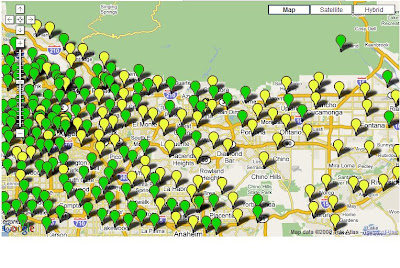
This is the ‘pins’ that show how the energy usage in my area. The green represents 0-5 levels of carbon emissions, and the yellow represents 5.1-15 levels and the red represents 15.1-999. Green is a great level of carbon emissions, yellow is ok, and red levels should be avoided.
If you are interested in finding out your carbon footprint for other than your primary footprint (like how much carbon is utilized during travel or household waste, visit: http://www.coolcalifornia.org/ A carbon footprint, usually looks like this:
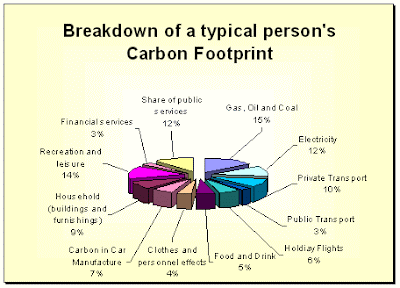
They give options to help reduce your carbon footprint: “Tips to Reduce Your Primary Footprint” according to http://www.carbonfootprint.com/carbonfootprint.html
Carbonfootprint.com also provides tips to reduce the secondary footprint
- When traveling for Holidays, they recommend avoiding air travel – as it uses more fuel than travel by land
- Utilize renewable energy or energy saving appliances as much as possible.
- “Try solar water heating – this can reduce your gas bill by up to 70% over a year.”
- Use public transportation as much as possible.
- Also, car sharing reduces your impact.
There are many easy ways to reduce your impact on the environment, and also save money off of your energy bills. Why not do something easy and helpful? Stay posted for more information about saving money on your electric bills!
- Pay closer attention to the materials you buy and the processes used to make them. So, for example, they recommend drinking bottled water because it is safe to drink tap water in most counties and recycling bottles adds to emissions.
- Buy as locally grown/made as possible. If local wine is produced, there will be less miles traveled, and therefore less emissions. The same goes for clothing. If clothes have to travel more than 1,000 miles, that is a large percentage of your footprint.
- Eat less red meat and avoid any goods that have unnecessary packaging.


Subscribe to:
Posts (Atom)


