
Keep Your Cool and Save Money Too: Summer Energy-Saving Tips from the Department of Energy Save 10 to 50 Percent on Utility Bills This Summer While Staying Cool WASHINGTON, D.C. -- Save money and keep your cool this summer by saving energy. As part of the Department of Energy’s (DOE) continuing outreach and education efforts, here are some easy, energy saving tips that are also available in a free guide for consumers. By following a few easy, common sense guidelines, properly maintaining or upgrading your air conditioner, adding insulation and taking other easy energy-saving measures, you can cut your energy bills by 10 to 50 percent. “Almost 45 percent of a homeowner’s utility bill goes for heating and cooling,” said Secretary of Energy Samuel W. Bodman. “By taking a few simple steps, American families can make their homes more energy efficient and can save a significant amount of money, too.” Your individual savings will depend on how energy-efficient your home is now, the type of home you have, and the area of the country where you live. Use Air Conditioning and Fans Wisely * Open windows and use portable or ceiling fans instead of operating your air conditioner. * Use a fan with your window air conditioner to spread the cool air through your home. * Use a programmable thermostat with your air conditioner to adjust the setting warmer at night or when no one is home. * Don't place lamps or TVs near your air conditioning thermostat. The heat from these appliances will cause the air conditioner to run longer. * Look for the ENERGY STAR® label. If your air conditioner is old, the new energy efficient models can save you up to 50 percent on your cooling bills. * Consider installing a whole house fan or evaporative cooler if appropriate for your climate.See all the tips for saving and staying cool on their website. Their low-cost tips allow for shade trees and weatherizing windows. All of these things can help homeowners to save money and stay comfortable.
Showing posts with label home energy. Show all posts
Showing posts with label home energy. Show all posts
Monday, July 27, 2009
Summer Savings!
Source: Department of Energy Summer Tips 2009: http://www.energy.gov/news/1652.htm Last access 7/27/09.
There are many different ways for you to keep your home cool and comfortable this summer without breaking the bank. The Energy Tips provided by the Department of Energy are broken up into several categories to help homeowners find what is right for them. They provide low cost tips, weatherization tips and general shade tips to name a few content areas.
Below are a couple of their tips-


Tuesday, May 26, 2009
Home Energy
If you have high energy bills, it's time to see what appliances are adding the most strain to your energy usage, and change out those appliances to energy star models.
Most often, the largest consumer of energy in the residential home is the heating and air conditioning systems. It is important to upgrade if you have an older, inefficient unit. The second largest consumer is then usually the refrigerator. This can also be avoided as there are many energy star efficient models to choose from. After that, the energy use is split amongst lights and other home appliances.Southern California Edison (www.sce.com) is currently running a program where they will switch any lamps that use inefficient energy for new energy star lamps. They will also collect cfl bulbs for recycling. To get all the information, please visit: http://www.sce.com/residential/rebates-savings/lighting/energy-star-lighting.htm They are holding events nearby during June and July to collect and re-distribute more energy safe lamps and lighting options. June 27 & 28, 2009 8 am - 1 pm Montebello Town Center Plaza Dr. & Montebello Blvd. Montebello, CA 90640 and then in July, they are going to be in Montclair. Why not upgrade? Changing out your lighting can make a difference in your energy usage and save you money on those monthly bills.
Wednesday, May 20, 2009
Home Energy
Energy Star is providing homeowner tips room by room, so that we can all take more notice of the specific workings of the energy use in each room. Today's installation comes right out of flex your power's monthly newsletter and covers energy use in the living room.
Source: Flex Your Power Monthly NewsletterClimate Change Room by Room: Top 7 Must-Follow Tips for Your Living Room Image: Energy Star The following article is the first installment in an on-going series in which we’ll explore unique ways to save in each room of the house. Summer is approaching, and these tips can help transform your living room into the coolest, most energy-efficient oasis in the neighborhood, while simultaneously saving you money. Whether you live in a temperate climate or a scorching desert, these 7 tips are living-room musts: 1. Compact Fluorescent Lights (CFLs): You know CFLs can save you 75% off lighting costs, but did you know they can save on cooling costs as well? A whopping 90% of the energy produced by incandescent lamps goes to heat, not light, whereas CFLs are much cooler. Hint: use the Energy Star lighting guide to get the light quality you desire. 2. Close Blinds or Shades Yep, it’s as easy as it sounds. Closing the blinds or curtains on south or west-facing walls can cut down on solar heat gain during the day. 3. Use Fans, We Can’t Stress This Enough If you use air conditioning, a ceiling fan will allow you to raise the thermostat setting about 4°F with no reduction in comfort. And here’s the best part: most ceiling fans use less electricity than a light bulb. Remember to turn fans off when you leave the room, since they work by creating a breeze to cool people, not rooms. 4. Arrange Furniture Properly Make sure your furniture isn’t blocking vents or air registers and double check that your air can circulate freely. It would be a shame to condition all that air, only to have it blocked by the couch or bookshelf. 5. Close the Fireplace Damper If your living room has a fireplace, make sure it is not leaking conditioned air out the chimney. Close the damper or seal your fireplace if it is no longer in use. 6. Plug Your TV into a Power Strip TVs, cable boxes, and other equipment continue to draw power even when they are turned “off.” Plug your living room electronics into a power strip and turn the strip off when they are not in use. You can also find smart meters which automatically cut off the power supply for you. 7. Use a Programmable Thermostat One of the best investments you can make is a programmable thermostat. It can help save you up to $160 per year and keep you comfortable by turning on heating or cooling according to your schedule. Already a pro at living room energy efficiency? Pass the savings along to friends or family members by sending them this story. Also, stay tuned for the next installment, where you’ll learn secrets to saving in the kitchen. Posted by Megan Toth on 05/18/09. Email story Filed under: Residential, Climate Change, Blog Post
Tuesday, March 31, 2009
Warm Water
While your HVAC system is one of the largest causes of energy use, there are other areas around your home that can reduce other costs.
Your water heater may also be using an outrageous amount of energy to heat water. Especially since this winter has been so chilly, I'm sure you took your share of warming showers or baths. Think about it - that water was still really warm when it went down the drain. That means that your water heater needed to heat a lot of water - the water that went down the drain, was never used again.This issue of waste led a Canadian company to come up with an easy-to-install drain/piping system that will convert the heat from the hot water going down the drain, and use it to heat new, clean water coming out of the "hot" tap.
This takes strain off of your hot water heater, because the heated water is being used to heat other water, saving you on energy bills.
Read more about these gadgets to help in your home at: http://www.ecogeek.org/content/view/2638/74/ or view the EcoDrain Website for more details: http://www.ecodrain.ca/en/
Every little bit helps when you are trying to save energy in your home. The water is completely safe, and it will take a toll off of your water heater. Something to think about at least. Happy showering.
Thursday, March 26, 2009
Its going to get HOT!
This summer is going to be HOT!
With all of the anomaly-like weather we have had this year, doesn't it make sense that the summer is going to be 30-40 degrees hotter than normal?
According to the National Weather Service Climate Prediction Center, visit for yourself at http://www.cpc.noaa.gov summer 2009, is going to be quite the hot one in Southern California.

What does that mean if you don't have air conditioning in your home? That you are going to be really hot...
What does that mean if your air conditioning system hasn't been serviced this year yet? That it is probably going to "putter" out during the hottest day of the year and you will have family visiting...and no air.
What does that mean if your air conditioner doesn't break down? That it is going to be working over time...and not running efficiently.
How to fix these things?
- Make sure your air system is serviced before the heat of summer. A qualified technician will ensure that everything is clean, the refrigerant is fully charged, nothing is leaking and/or overflowing, there is no corrosion or build-up and that the electrical and wiring is operating correctly.
- Run your air conditioner according to the energy star recommendations - set your thermostat to around 75 if you can stand it. Your air system will not cool faster if you crank the numbers down to 60 degrees, so your house will still be the same temperature and your bills will be super high - plus, if your system is correctly sized, if you set your thermostat super low, it will turn off too quickly - before the house is completely (equally) cooled.
- Make sure your system is up-to-date. If your system was installed in the 1980s or 1990s, it is running at a way lower SEER (efficiency ratio) than units installed today. You want to think about it: If your unit is on all the time (as warranted by 30-40 degrees above normal heat) do you want it to be as efficient as possible? The answer is YES - because that saves you in energy costs. If you run an energy efficient unit, you could save around $40 for every $100 a normal energy bill would come to (meaning you are paying $60 not $100...).
So make sure that you have completely examined your options this summer, before that first energy bill lands on your porch.
Wednesday, March 18, 2009
Apartment Energy
So, you live in an apartment and want to save money on your energy bills, but can't talk the landlord into installing a new fridge?
Flex Your Power (www.flexyourpower.org), an energy non-profit based out of Southern California has a recent article that gives 22 low-cost things that you can do to save money in an apartment. Visit their suggestions here: http://www.fypower.org/news/?p=6186 Some of the simple things that they suggest for energy savings are replacing shower heads with low flow versions (and keeping the old shower head) so that you can reattach the old shower head (and take your low flow version onto your next residence). Sealing up cracks and draft-ways are useful in any home. But, being that this residence is less temporary, there are ropes and other temporary solutions that can be added around windows and doors and then removed later. The usual suggestions include setting your thermostat (higher in the summer and lower in the winter) and using blankets in the winter or fans in the summer as well as keeping curtains etc. drawn to keep out the heat of the day. There are many other useful suggestions, like displacing water in your toilet? and changing lightbulbs to CFLS. If you are currently living in an apartment, FYP has some great suggestions that will make a big difference in your energy bills. Also, if you are a homeowner stripped for cash, these temporary fixes might help you out along the way too - but remember these are easy, TEMPORARY fixes, eventually you will need to bunker down and upgrade to more efficient appliances etc.Tuesday, March 17, 2009
Question?
Ever had a question about energy use and not known where to go for information?
The aptly named "The Home Energy Saver Answer Desk," here on this site, the Berkeley Laboratories (experts in Energy savings) have brought many of their FAQ pages to a single location so that homeowners can find information on practically any energy question.Visit them for yourself: http://hes.lbl.gov/hes/answerdesk_dat.html
They highlight questions from how to save energy on your second home to how much savings you can expect from energy star appliances. Here is an interesting Q & A"What's the single biggest user of electricity in my house? If your house has central air conditioning, the air conditioner will probably be the biggest user by far. Although used only a few months of the year, the annual cost can be much greater than the annual cost of your refrigerator, which is typically the next largest user. In hot climates, the annual air conditioner cost can exceed a thousand dollars. You can get a very rough idea of what your air conditioner is costing you by subtracting the electric portion of your bill in a spring month when you aren't using your air conditioner from the electric portion of the bill in the summer when you do use it. This gives you the monthly cost. Multiply this by the number of months you use your air conditioner to arrive at your approximate annual cost. Refrigerators are typically the largest users in houses without air conditioning or in climates where the air conditioners are used only a few days of the month during the cooling season. If your refrigerator is more than ten years old should consider replacing it. New efficiency standards went into effect in 1992, and older refrigerators are typically two to three times more expensive to run than a new unit. For more information go directly to the American Council for an Energy-Efficient Economy's list of most efficient refrigerator-freezers. See our list of typical energy use costs for various appliances and equipment."Being that your central AC can be the largest energy guzzler in your home (and if not that, your refrigerator) it is important to the bottom line of your energy bills that those appliances are energy star. The higher the SEER on air conditioning units, the more money you can possibly save! What about using heaters to bring that thermostat down? Does it work?
"Should I use portable room heaters to lower my energy bills? With rising energy prices, it's tempting to think about using portable room heaters. It's also worth considering a programmable thermostat, if you don't already have one. If your central heat is electric, you'll almost certainly save money by using portable electric heaters. In fact, part of the savings come because valuable heat isn't being lost in the ducts before it reaches your living area. If your central heat is gas, you might be able to save money by using portable electric heaters, but it's not something to take for granted. Your local energy prices and desired comfort level will determine the answer. Also, a typical central furnace will provide about 20-times as much heat as a portable, depending on its efficiency. Keep in mind that even if the hourly cost of using portable electric heaters is lower than for your furnace, you will be dramatically increasing your home's overall power demand, which contributes to regional power shortages that ultimately can trigger blackouts and price increases. We've put together the following chart to help you find out how much your heating bill could be reduced by using portable electric heaters. To use the chart, follow this four-step process: 1. Find your gas price on the left hand vertical scale and read over to the right until you hit the scale marked "Your Heating Bill." This is the hourly cost of running a 100kBtu/hour central furnace. 2. Next, find your electricity price on the horizontal scale and read upwards until you hit the yellow line corresponding to how many portable heaters you would like have on at one time (one to five). 3. Next read from this point over to the "Your Heating Bill" scale to find the hourly cost of running a typical 1000 Watt portable electric heater. 4. Compare the two hourly operating costs to see which is lower. In the illustrative example provided, a home paying $0.75/therm of gas and $0.25./kWh would save money if using two portable electric units. They would break even using three and would have an increased heating bill for using more than three portable heaters.So, it all comes down to energy efficiency... This site has a wealth of information in questions and answers. Even if you don't have a question at the moment, it might be a good site to bookmark just in case you ever have questions.

Monday, February 23, 2009
High Bill Help
Source: "Outrageous Power Bill Spurs Couple to Seek Audit" by Earl Neikirk/Bristol Herald Courier.
If your energy bills are higher than you think they should be is there really anything you can do to change that?
YES!
Contrary to popular belief there is usually something (and something fairly easy at that) that you can do as a homeowner to determine where your energy is being used and how to change that usage or conserve more energy. While there are several different options that you can do, the couple in this article opted instead for a home energy audit. These are usually provided by your power company, an energy use company or even a private contractor. The specialist will come to your house and ask you questions about how your energy is being used - so that he or she can determine where energy use can be saved without affecting your lifestyle too drastically. Then they will measure how much air is escaping from the house as well as the state of your equipment. This may be done a variety of different ways from infrared tracking to electrical air pressure measurement.To find energy auditors in southern California...
First visit: http://www.fypower.org/res/energyaudit/professional.html this page gives you tips and suggestions on how to choose an auditing company as well as some sample questions that the auditor may ask you. You can find a local contractor by calling 888-357-1777 in Southern California. They will then provide you listings of energy auditors near you. If you want, you may also check with your local power company. For example, Southern California Edison has an energy auditing program. To learn more, visit their webpage:http://www.sce.com/_Tools/Residential/HomeEnergySurvey.htm Its in the section under the heading "In-Home Energy Survey""In one short visit to your home, a trained expert will help you improve your home's energy efficiency and lower your energy bills. Our energy service representatives are trained to evaluate when and how you use electricity, water and natural gas. After a brief survey, they will provide suggestions to guide you in making your home more energy efficient — reducing your energy bills, improving your home's comfort, and protecting the environment. Don't delay. Get started saving energy and money by making your home more energy efficient with our Free Home Energy Efficiency Survey. Schedule your money-saving home energy survey today by calling (800) 278-8585. Trained energy experts are available to meet with you at home or by phone any time between 8:00 a.m. and 6:00 p.m., Monday through Friday, and on alternate Saturdays.The more you know about the way you are using energy in your home, the more ways you can find to cut back and save some green. Don't be like these homeowners who are stuck with a hefty bill.
Thursday, February 12, 2009
Flex Your Power
 Flexyourpower.org has a box on their opening page which allows you to input your zip code. Upon entering said zipcode, it then takes you to a page listing all of the rebates, incentives and services in your area. Rebates are based on money that local companies or even the federal government are providing in your area for upgrading appliances to newer, more efficient versions.
 In Covina, the site that you would get taken to is found here: http://www.flexyourpower.org/res/tools/rgl_results.html?z=91723&s=res.
The Rebates currently offered include:
If you are in the market for one (or several of these new appliances) it might be a good idea to see which models allow for rebates - or even tax refunds for next year. Every bit counts...
The Incentives section covers various ways and reasons to upgrade your home. For example, if you have a pool or spa - heating that 'puppy' can be very expensive. Sometimes the government or other local governing bodies will chip in or provide breaks to homeowners who are willing to heating their pool or spa in a cheaper, more efficient way. This helps all of us, because there is then more energy to be used elsewhere it is needed.
Then, they also list services in your area. Has your home been drafty this winter? Maybe you need to put in more insulation and caulk around the windows. If you're not the 'handy' type - or are too busy to finish a project, there are links on this page to people who will do those upgrades for you. There are 7 companies recommended on the website that will perform a home energy audit (to see where energy is escaping from your home and suggest ways to fix that). These are also good things to look into if your energy bills are higher than you think they should be.
If you are considering making some upgrades to your home or office, these are reputable companies recommended by the flex your power non-profit. It's a good place to start. Flex your power also offers information about other ways to save energy and money around your home. If you have a free afternoon it might be time well spent. And plus! You will totally have random information to share at parties!
Monday, February 9, 2009
Energy Use Yardstick
The energy bill comes every month - and you pay it. That's just how it works. But have you ever wondered if your energy bill is too high? Have you thought about easy changes that your family could make to significantly improve the energy bill's bottom line?
AND
even if you have...how do you figure out what you should change? Well, energystar.gov (R) is here to help. They have a home yardsticking feature that helps you to compare your home's energy use with what a super efficient home the same size as yours would use. Then you can decide which repairs/upgrades/changes will work best for you and your budget.
Visit the home yardstick initial page here: http://www.energystar.gov/index.cfm?fuseaction=HOME_ENERGY_YARDSTICK.showGetStarted
It is an easy and interactive website where you enter some simple information and then the website provides information based on your answers. The first input is the zip code where the home is located. Make sure you have an electricity bill from the previous month to get an accurate count. You just input how much electricity and other types of fuel you have used during the month.
It is a good idea to know how much energy your home is using.
Tuesday, January 27, 2009
Setting the Thermostat for Optimum Comfort
During the winter months it can be difficult to find the "optimum" comfort level indoors. Houses and apartments can either be too cold or too warm - neither of which is comfortable.
But what's a homeowner to do?
It can be difficult to find the right temperature for your home. Ideally, the recommended setting during the winter is 68 degrees. However, everyone has their own levels of comfort. A word of caution though: it is better to be chilly and put on a sweater than to run your heater at 90 degrees. In fact, each degree you drop your furnace during the winter can save you one to three percent on energy costs. Some common misconceptions:Turning the thermostat on as high as it will go as soon as you get home will warm up the house faster!
FALSE!
According to the article:"Second, when you come home at the end of the day to a house that is colder than you'd like it, don't immediately turn the thermostat as high as it can go "to heat the house faster." It's just not going to happen. The furnace isn't going to put out any more heat if you set it for 90 than if you set it for 68. What it will do if you set it higher than you want it, though, is continue to put out heat until you remember to turn it back to is desired setting. As a result, you might be wasting an awful lot of heat when you don't need it or want it to get higher than your desired comfort level. Setting it higher than you want it won't make it heat any faster."
You should turn your heater off when you leave the house or go to sleep.
false-ish...
I know some people prefer to turn off/unplug appliances when they leave or go to sleep. For those of you that follow that M.O. - I understand that it is too much to ask to leave these large energy-users running. However, here are some things to take into consideration.- It is easier (it takes less energy) to raise the temperature three degrees than twelve degrees.
- If the temperature in your home drops below a certain point, the walls may freeze and so also the pipes. If the pipes freeze, you can be in trouble. Regardless that this may not happen often in Southern California - It IS possible and with the weather we are having this year...I would suggest that it is better to be safe than sorry.
" usually tell people that there are a couple of basic rules that you won't find in an instruction book for properly operating their thermostat or heater or air conditioner, but they're strategies that will keep their home more comfortable and help keep energy use to a minimum. Let's talk about the heating season right now, though the general ideas here work just as well in hot weather (with the appropriate adjustments in direction of the thermostat setting, of course). First of all, it is a good strategy to turn the setting down a few degrees when the house is empty, like when you're all at work or school during the day. Maybe you've had it set at 68 degrees, for example, so if it's going to be empty for several hours, turn it down to 62 or 63 while you're gone. I've seen research that shows that for every degree you can turn the thermostat down from its usual setting, you can save anywhere from 3 to 10 percent on the heating costs during that time (the variance is due to various factors including the overall energy efficiency of the home, including its insulation levels, quality of windows, etc.)."He also suggests that it is unnecessary to be "locked" into a certain thermostat setting for all winter, but that depending on comfort, the temperature outside, how many people you have in the house and other factors should determine what the thermostat is set to. Good Luck, and happy thermostat-ing.
Wednesday, January 21, 2009
How to Heat Your House...
Source: "Warm Up
How to heat your house—not the outside."
By Meaghan O'Neill and treehugger.com
Updated Tuesday, May 29, 2007, at 12:26 PM ET
More than 20 percent of the carbon dioxide emissions in the United States come from energy use in homes. A major source of the problem is heating, and even though we're heading toward summer, heat is still an essential element in reducing your carbon load for the year. Some of us keep our homes warmer than we need to—if yours feels like an icebox in summer and a toaster in winter, you're probably in this group. In addition, most houses leak some hot air (and, in the summer, cool air) from every window, doorway, and air duct, which means that they're constantly wasting energy, and thereby upping CO2 emissions.According to O'Neill there are always the alternatives to regular energy use. The article cites solar and wind energy, as well as geothermal heat sources - which are very "green" and will help your wallet in the long run. However, the article also gives suggestions if you are heating your home through traditional methods of gas or oil furnaces. Here are some suggestions:
• Chimneys of traditional fireplaces are designed to remove the byproducts of a fire by creating a draft. That means they suck heat from your home, even when they're not in use. It's a good idea to keep the damper closed. Better than a fireplace (or you could install one inside it) is a wood-burning or pellet stove. They supplement your regular heat source, are more efficient, and use fuel that's much cleaner and cheaper. • OK, so you're really stuck—you live in an apartment and can't choose where your heat comes from, or maybe even what temperature the thermostat is set to. You can still deal with your carbon sludge by purchasing carbon offsets for your home through programs like TerraPass. Your home won't get a direct delivery of green energy. But you'll be investing in it.There are many different options for heating your home, ranging from pellet stoves to under-floor heating pipes to traditional furnaces and even space heaters. Whatever the method for heating your home, the goal is always to be comfortable and not break the bank. It might be time to start looking into some greener alternatives that will give you more comfort in home and maximize their efficency.
Wednesday, November 5, 2008
Great Video!
If you are trying to find ways to cut costs for the winter, this video is a great place to start. It is very well done, short and extremely helpful.
Monday, October 20, 2008
High Energy Bills?
SCE can help. If you live in the southern California Area and are paying your huge chunk of electricity payments to Southern California Edison (www.sce.com) they have some tips to save some green.
So their site "Top 10 Energy Guzzlers" http://www.sce.com/CustomerService/HighBillHelper/energyguzzler.htm under their "High Bill Helpers" section has an interactive picture of 10 appliances in your house that can be causing that high energy bill.
1 of the 10 (actually #9) is the central air conditioner. Edison averages about .17 per kilowatt hour and they used a 3 Ton unit for example. They guess that if you have an inefficient model, you can pay $80.46 running it for 4 hours a day. If however, you have a higher SEER you can save money without having to turn the thermostat up to 82.
(things to remember)
1. The current government standard in SEER (seasonal energy efficiency ratings) is 13. A seer of 13 is saving you 30% over a 10 seer (a unit maybe 5-7 years old).
2. If you pay $100 for your energy bill and upgrade to a 13 SEER, you will be saving 38% and now paying $62 for that same bill (according to residential.carrier.com's calculator).
3. The agreed upon temperature for optimal savings and optimal comfort is 78 degrees and higher when you're away from home.
4. Your thermostat isn't saving you any money if you are using it as a manual model (turning it on and off when you want to).
Okay, check out the suggestions, many of them are common sense, some of them are weird (like get flat bottomed pans to avoid using too much electrical stove time - who sells rounded pots? and how do they stand up?....weird). But worth a look anyhow. They also have more tips on how to lower your energy bill under their High Bill Helpers section.
Thursday, June 12, 2008
How Does Your Home Measure Up?
Have you ever wondered if you are doing enough of your part to save energy during the hot summer months? Do you wonder how your neighbors are doing?
Homeenergy.org published an article entitled “Comparing Your Home’s Energy Use to Others,” which can be found on their page http://www.homeenergy.org/consumerinfo/benchmarking-energy-usage.php.
One of the easiest and low-tech ways to determine an estimate of your home’s energy usage is benchmarking. In the article, the “do-it-yourself” section provides a section on what benchmarking is and how to do it. What is is: Benchmarking is a way to roughly compare the energy your house is using to the energy used by similar houses near by.
It is an easy to do, somewhat accurate way to get an idea of how energy efficient your home is.
If you want to do this manually, as described in the Home Energy article, you will need to know how much fuel you used last winter, the square footage of the heatable space in your house and about how cold the weather was. However, if you are like me and try to avoid math, you can head over to http://hes3.lbl.gov/hes/hes.taf?f=top. This takes us back to a very helpful web page, The Home Energy Saver web site. This site will give you an average electrical bill for homes in your area (found by typing in your zip code). Then, the web page will also generate a possible bill if energy saving appliances and techniques were used.
In my case, our zip code is 91723.
 The average Home Energy Bill for Homes in my zip code is $1,314.
 The average Home Energy Bill for Homes in my zip code is $1,314.
The Home Energy Bill with Energy Efficient appliances/precautions is $899.
That's a savings of $415 a year.
If that is enough information for you, you can stop there. But if you want to see how your energy bill can look more like the lower estimate, there are questions on the bottom section of the page that you can answer that will give you a ‘prescription’ of appliances to change out or upgrade to impact your bill. These questions include describing the type of insulation in your home, the number of windows and even the geographical direction your home faces. After answering basic questions like these, the website will then generate a calculation of possible upgrades you can make to your house and the amount of money those upgrades would save you (with the payback amount and time period already factored in). Upon completing the questions and calculations you will be taken to a “results” page where you can then map your homes carbon footprint. This was very interesting to me. According to http://www.carbonfootprint.com/carbonfootprint.html, a carbon footprint is“is a measure of the impact human activities have on the environment in terms of the amount of greenhouse gases produced, measured in units of carbon dioxide.”
The explanation continues as the web page splits the carbon footprint term into a primary and a secondary footprint (explaining corresponding calculations used in the definitions). The whole carbon footprint is found by adding the primary and secondary traits together. The primary footprint is the direct usage of fossil fuels (like driving in your car, or taking a flight). The secondary footprint comes from products we buy and how long it is going to take for the products we buy to decompose. The carbon footprint calculator on energy website calculates your “carbon footprint” a little bit differently because it is examining the energy usage of your home, not you as an individual. It also has a mapping system so that you can compare your energy usage with the median usage of homes near you (in your same zip code) as well as others on the map. To see the numbers the calculator uses as well as the methodology please visit http://hes3.lbl.gov/hes/footprint_map/index.taf?session_id=1110331&_UserReference=5621E7A2A0F286594851845B. After you have input your information and viewed the map of your zip code, the “summary stats” tab allows you to see your energy consumption on a graph compared to “Annual Metric Tons of Carbon Dioxide Emissions per Home” other homeowners, as well as a line representing homeowners across the United States.
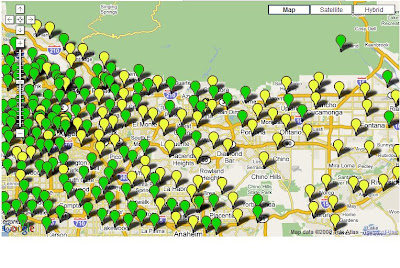
This is the ‘pins’ that show how the energy usage in my area. The green represents 0-5 levels of carbon emissions, and the yellow represents 5.1-15 levels and the red represents 15.1-999. Green is a great level of carbon emissions, yellow is ok, and red levels should be avoided.
If you are interested in finding out your carbon footprint for other than your primary footprint (like how much carbon is utilized during travel or household waste, visit: http://www.coolcalifornia.org/ A carbon footprint, usually looks like this:
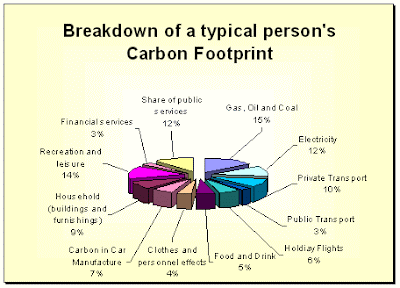
They give options to help reduce your carbon footprint: “Tips to Reduce Your Primary Footprint” according to http://www.carbonfootprint.com/carbonfootprint.html
Carbonfootprint.com also provides tips to reduce the secondary footprint
- When traveling for Holidays, they recommend avoiding air travel – as it uses more fuel than travel by land
- Utilize renewable energy or energy saving appliances as much as possible.
- “Try solar water heating – this can reduce your gas bill by up to 70% over a year.”
- Use public transportation as much as possible.
- Also, car sharing reduces your impact.
There are many easy ways to reduce your impact on the environment, and also save money off of your energy bills. Why not do something easy and helpful? Stay posted for more information about saving money on your electric bills!
- Pay closer attention to the materials you buy and the processes used to make them. So, for example, they recommend drinking bottled water because it is safe to drink tap water in most counties and recycling bottles adds to emissions.
- Buy as locally grown/made as possible. If local wine is produced, there will be less miles traveled, and therefore less emissions. The same goes for clothing. If clothes have to travel more than 1,000 miles, that is a large percentage of your footprint.
- Eat less red meat and avoid any goods that have unnecessary packaging.


Subscribe to:
Posts (Atom)


